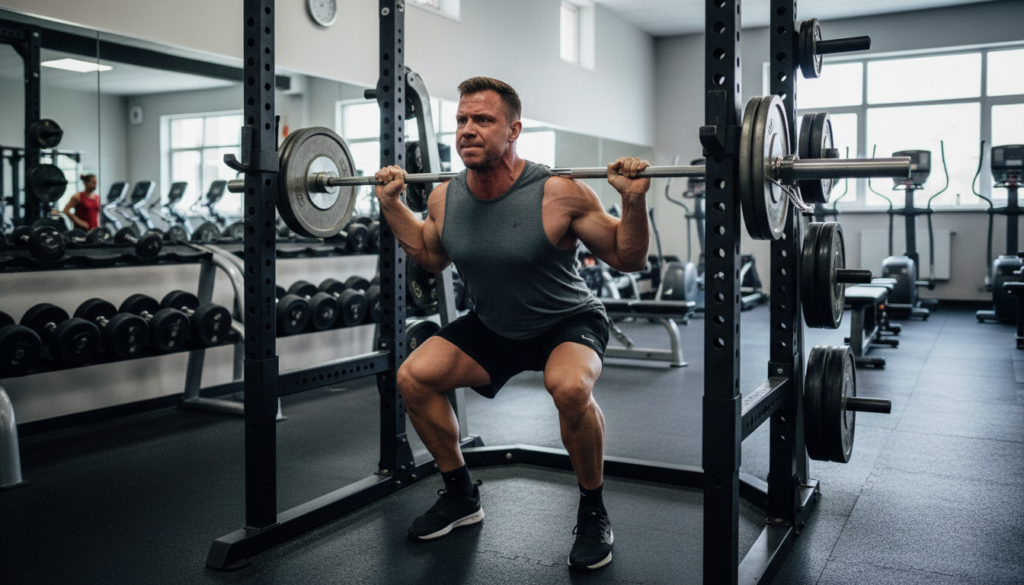
The break between series It's the time you allow to elapse between finishing one set and starting the next. It seems like a minor detail, but it's one of the variables that most influences your results. If you rest too long, you lose training density. If you rest too little, you don't lift the weight you're supposed to. In both cases, you're missing out on potential gains.
The good news is that adjusting the rest between sets It's no mystery. It mainly depends on three things: your goal, the type of exercise, and the intensity. In this guide, you'll see how much rest you need depending on whether you're aiming for strength, hypertrophy, or muscular endurance. It includes a practical table, the most common mistakes, and how to stay on track without constantly checking the timer.
What is the break between series and why does it matter?
When you lift a demanding load, your muscles quickly deplete their fuel supply: the system of phosphocreatine. That system takes between two and five minutes to recover almost completely. Rest serves precisely that purpose: it replenishes energy, removes metabolites, and allows the nervous system to perform at its best again.
If you don't get enough rest, each set will be more fatigued than the last. Your repetitions will decrease, your technique will worsen, and you'll accumulate fatigue without any real increase in training intensity. That's why getting proper rest isn't "wasting time." It's what allows you to perform quality sets and apply the necessary techniques. progressive overload week after week.
How much rest between sets depending on your goal
There is no single magic number. The ideal timeframe varies depending on your goals. This table summarizes the ranges supported by current evidence:
| Aim | Recommended rest | Because |
|---|---|---|
| Maximum force | 3–5 min | You recover energy and your nervous system to move heavy loads. |
| Hypertrophy | 1.5–3 min | Balance the load with the total volume of quality. |
| Muscular endurance | 30–60 s | It maintains tension and trains fatigue tolerance. |
| Power and explosiveness | 2–5 min | Each repetition should be quick and without accumulated fatigue. |
As you can see, the range goes from half a minute to five minutes. The difference is huge, so it's worth understanding each case.
Strength: long rest periods to perform at your best
If your goal is to lift heavier weights, you need longer rest periods. In heavy exercises like squats, deadlifts, or bench presses, rest for three to five minutes between sets. It might seem like forever, but that's what it takes to move loads close to your maximum.
The reason is simple: strength depends heavily on the nervous system, and the nervous system fatigues quickly. With short rest periods, your repetitions plummet and the strength stimulus disappears. If you want to know what weights to work with, this will help. calculate your 1RM and program the correct percentages.
- Heavy multi-joint exercises: 3–5 minutes.
- Sets above 85% of your 1RM: do not go below 3 minutes.
- Prioritize the quality of each repetition over haste.
Hypertrophy: the middle ground that builds the most muscle
To gain muscle mass, the rest period between sets should be moderate: from one and a half to three minutes. This range allows you to recover enough to maintain good repetitions without lengthening the session too much.
For years it was believed that very short rest periods, of one minute, maximized hypertrophy due to "metabolic stress." Recent research disproves this: with rest periods of two to three minutes you lift more weight and build more muscle. training volume quality and you'll grow just as much or more. Adjust the time according to the exercise and your repetition ranges.
- Large exercises (squat, row, press): 2–3 minutes.
- Isolation exercises (curls, extensions): 1–2 minutes.
- If you're unsure, rest a little longer: it's more important than rushing.
Muscular endurance: short breaks and control
If you're looking for endurance or a more "pumping" workout, short breaks make sense: thirty to sixty seconds. The goal here isn't to lift the maximum weight, but to tolerate fatigue and sustain the tension for longer.
Keep in mind that this method is very tiring and not the most efficient for gaining strength or muscle. Use it in specific phases, in circuits, or for accessory exercises, not as a general rule for your entire workout.
Factors that change your rest time
The ranges above are a guide, not a hard and fast rule. Several factors will affect your specific situation:
- Exercise size: A heavy deadlift requires more rest than a bicep curl.
- Intensity: The closer to failure and the greater the load, the more time you need.
- Your level: Advanced people move larger absolute loads and usually require somewhat longer breaks.
- The available time: If you're short on cash, shorten breaks on accessories, not on the basics.
- Your recovery for the day: If you slept poorly or ate little, your body will ask for more rest.
Common mistakes with rest between sets
These are the most common shortcomings I see that hinder the progress of many people:
- Go in a hurry for the basics. Cutting short the rest period in squats or presses due to impatience will ruin your performance and technique.
- Rest "by eye". Without measuring, a two-minute break turns into four minutes between the mobile phone and the conversations.
- Copying someone else's break. Your colleague moves different loads and is at a different level; their pause doesn't have to be yours.
- Do not adapt it to the exercise. Using the same time for a deadlift and a curl is a classic mistake.
If you feel like you haven't made progress in weeks, check these out too. strategies to break a stalemate: often the problem is not just rest.
How to time your breaks without becoming obsessed
The key is to measure, but without turning the gym into a walking timer. Use a timer that starts as soon as you finish a set and alerts you when it's time for the next one. This way, you keep your rest periods consistent and comparable between sessions.
Over time, you'll learn to "listen" to your body: when your breathing calms down and you feel you can push hard again, it's usually a good sign. But at first, it's best to rely on data, not feelings.
Frequently Asked Questions
How much rest between sets to gain muscle?
Between one and a half and three minutes for most exercises. For heavy compound exercises, aim for closer to three minutes; for isolation exercises, one or two minutes is sufficient. The important thing is to have enough energy to complete each set.
Is it bad to rest for more than 5 minutes?
It's not "bad," but it's rarely necessary except in maximum strength or powerlifting. Very long rest periods significantly lengthen the session and cool the muscle down. For hypertrophy, exceeding five minutes doesn't offer any clear advantages.
Should I rest the same amount during large and isolation exercises?
No. Multi-joint exercises are much more tiring and require more rest. You can recover from a curl or extension in one or two minutes, while a heavy squat might need three or more.
How MyPeak helps you control rest between sets
Measuring rest manually is easy to forget. With MyPeak You record each set and use a built-in rest timer, so every break is exactly as planned. Plus, the app estimates your 1RM, saves your personal records, and tracks your strength progress with clear analytics.
This way you can verify, with real data, whether that change in rest is improving your lifts or not. Instead of guessing, you make informed decisions. And it all stays within your private progress, without social media or distractions.
Conclusion
Rest between sets is a simple yet powerful lever: three to five minutes for strength, one and a half to three minutes for hypertrophy, and thirty to sixty seconds for endurance. Adjust it to your goal, the exercise, and your fitness level, measure it consistently, and you'll see how your workouts improve. Start tracking it today with MyPeak and let your numbers lead the way.