
Knowing how much protein to gain muscle What you need each day is one of the decisions that most influences your results. You can train intensely, rest well, and be consistent, but if you don't eat enough protein, your body won't have the building blocks to construct new muscle tissue.
The good news is that you don't need to obsess over it or weigh every gram. With a clear target number and a few quality sources, meeting your needs is easier than it seems. In this guide, you'll see how many grams you need based on your goal, what the best sources are, and how to distribute your protein throughout the day to get the most out of it.
How much protein do you need per day?
The evidence is fairly clear on this point. To maximize muscle mass gain, most people who strength train need between 1.6 and 2.2 grams of protein per kilogram of body weight per day. Below 1.6 g/kg you leave gains on the table; above 2.2 g/kg the additional benefit is minimal for almost everyone.
Let's look at an example. If you weigh 75 kg and your goal is to gain muscle, your target would be between 120 and 165 grams of protein per day. Choose a point within that range and stick with it: consistency matters much more than hitting the exact number every day.
| Aim | Protein per day (g/kg of body weight) |
|---|---|
| General health and maintenance | 1,2 – 1,6 |
| Gain muscle (volume) | 1,6 – 2,2 |
| Define in caloric deficit | 2,0 – 2,4 |
| Endurance sports | 1,4 – 1,8 |
An important note: if you have a significant amount of body fat, calculate your protein intake based on a weight closer to your target weight or use your lean mass as a reference. This will help you avoid inflated figures that offer no extra benefit and only complicate your daily routine.
Why protein is key to hypertrophy
Your muscles are in a constant state of flux between building (synthesis) and breaking down proteins. To grow, you need muscle synthesis to exceed muscle breakdown at the end of the day. Strength training is the stimulus that triggers this process, and dietary protein provides the amino acids that make muscle tissue repair and growth possible.
One factor that makes a difference is leucine, an amino acid that acts as a switch for muscle protein synthesis. Animal sources and whey protein are especially rich in leucine, which is why they are so effective. With plant-based sources, simply eating a slightly larger quantity and varying your diet will equalize the stimulation.
Without enough protein, even the best training program will underperform. That's why, along with a good weekly training volume and the progressive overload, Protein intake is part of the trio that truly determines your long-term gains.
The best sources of protein
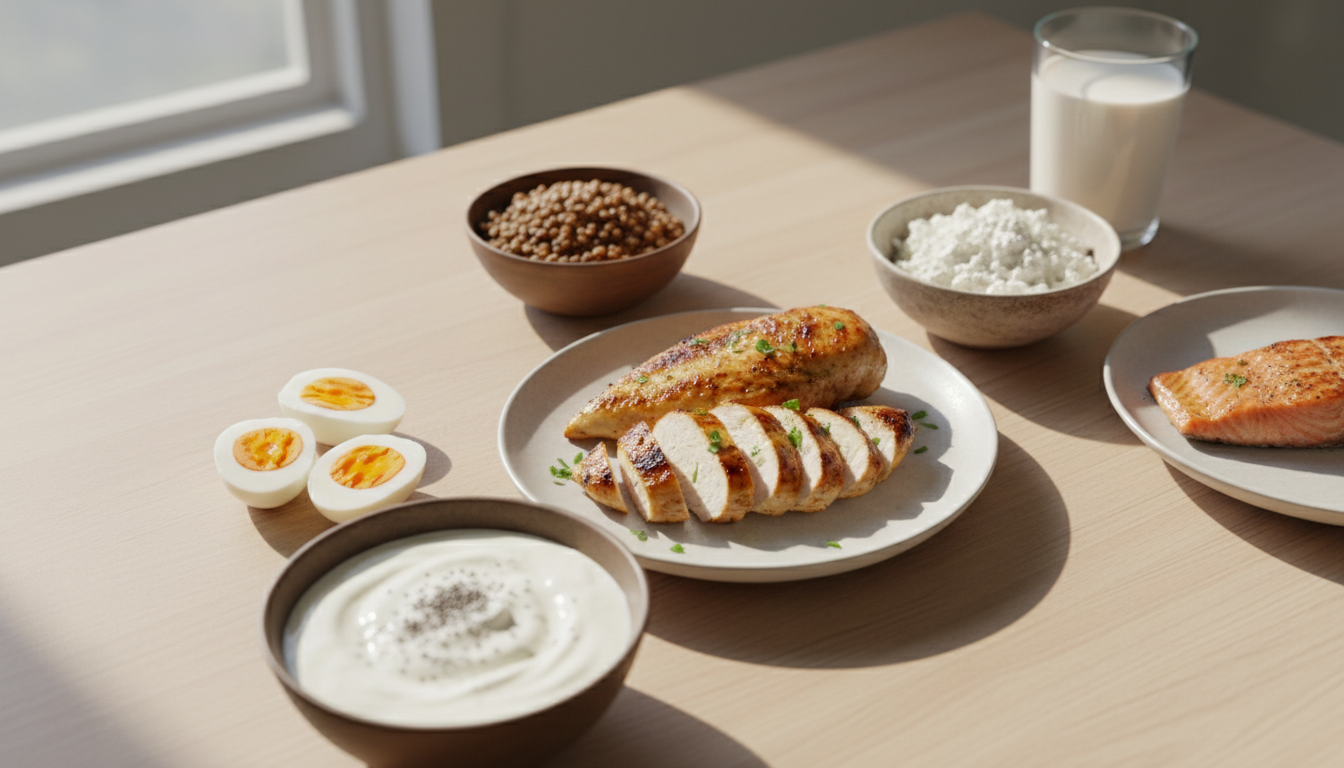
Not all proteins are created equal. Animal-based proteins typically provide all the essential amino acids in good proportions and are easily digested. Plant-based proteins are also suitable, although it's best to combine them to ensure a complete protein profile. Here are some common sources and their approximate content:
| Food | Protein (per 100 g) |
|---|---|
| Chicken breast | ~31 g |
| Lean veal | ~26 g |
| Canned tuna | ~25 g |
| Salmon | ~20 g |
| Egg | ~13 g |
| Natural Greek yogurt | ~10 g |
| Cooked lentils | ~9 g |
| Tofu | ~8 g |
| Whey protein (30g scoop) | ~24 g |
By prioritizing a serving of protein at each main meal, you've already done almost all the work. Supplements like whey are convenient, but not essential: they're just a practical way to add grams when you're short on food. Along with protein, the creatine It is the other supplement with the most scientific backing for gaining strength and muscle.
If you follow a vegetarian or vegan diet, combine legumes with grains, add soy in its various forms (tofu, tempeh, edamame), seitan, and, if desired, a plant-based protein isolate. By properly distributing your nutrient sources, meeting your daily goal is perfectly achievable without animal products.
Does protein intake change depending on whether you're bulking or cutting?
The objective slightly modifies your needs. In a phase of volume, With a caloric surplus, the excess energy itself facilitates growth, so 1.6–2.0 g/kg is usually sufficient. In definition, When you're eating a calorie deficit to lose fat, increasing your protein intake to 2.0-2.4 g/kg helps preserve the muscle you've worked so hard to gain. In other words, the more aggressive the deficit and the more defined your physique, the more protein you should prioritize.
How to distribute protein throughout the day
Spreading your protein intake across several meals helps maintain high muscle protein synthesis for longer. A good guideline is to consume between 0.4 and 0.55 g/kg per meal, which for most people translates to 25-45 grams of protein per meal. Distribute it as follows:
- Distribute it over 3-5 meals throughout the day instead of concentrating it into one huge shot.
- Include a quality source in every meal: meat, fish, eggs, dairy products or legumes.
- Be mindful of the food you eat close to your workout., Although the window is not as narrow as previously thought: what matters is the daily total.
- Don't neglect taking it before bed.; A slow-digesting source, such as Greek yogurt or cottage cheese, works very well.
A sample day to cover your protein
The theory is best understood with a real-life example. Imagine a 75 kg person aiming for about 150 grams of protein per day. It's that easy to distribute this amount without resorting to complicated menus:
| Meal | Example of food | Protein approx. |
|---|---|---|
| Breakfast | 3 eggs + a Greek yogurt | ~30 g |
| Meal | 150g chicken breast + lentils | ~50 g |
| Snack | Whey shake + a piece of fruit | ~25 g |
| Dinner | 150g of salmon + vegetable garnish | ~35 g |
| Before going to sleep | A bowl of cottage cheese | ~15 g |
The total is around 155 grams, right on target, and with regular meals you can easily prepare. If you miss a day, no worries: what matters is the average over the week, not daily perfection. Adjust the portions to your weight and preferences, and you'll have a template that adapts to almost any situation.
Common mistakes when calculating your protein for muscle gain
These are the most common mistakes that should be avoided:
- Confusing grams of food with grams of protein. 100g of chicken is not 100g of protein, but about 31g.
- To rely entirely on smoothies. They are a temporary support, not the basis of your diet.
- Eating very little protein at breakfast and having to make up for it at night in a rush.
- Neglecting the rest of the calories. Without enough total energy, it's difficult to gain muscle even if the protein is perfect.
Frequently Asked Questions
Do I need to take protein shakes to gain muscle?
No. You can meet all your needs with just whole foods. Shakes are convenient and inexpensive, but they're optional: use them if they help you reach your daily goal more easily.
How much protein can the body use in a single meal?
The body utilizes virtually all the protein you eat, just at different rates. To maximize muscle protein synthesis, a range of 25 to 45 grams per meal is very reasonable for almost everyone.
Does eating a lot of protein damage the kidneys?
In healthy individuals, high protein intake does not harm the kidneys, according to available evidence. If you have pre-existing kidney disease, consult your doctor before increasing your protein intake.
How MyPeak helps you gain muscle
Eating well is of little use if you don't know if your training is progressing. MyPeak Record your routines, calculate your Estimated 1RM, It saves your personal records and shows you strength analytics so you can see, week by week, if you're truly progressing. Plus, its AI Coach guides you in adjusting volume and loads without guesswork.
If you want to turn your efforts in the kitchen and at the gym into measurable results, Try MyPeak for free and start tracking your progress today.
Conclusion
Adjust your protein to gain muscle It's no mystery: aim for 1.6-2.2 g/kg per day, spread it across several meals, prioritize quality sources, and be consistent. Combine it with a well-structured training program, and the growth will come. And to keep track of your progress, Keep track of your records with MyPeak And let the data confirm that you're on the right track.