How long does it take to gain muscle? It's probably the most frequently asked question in any gym. And also the one that's answered the worst. Social media is full of twelve-week transformations promising a new body, while reality progresses much more slowly. This gap between expectations and reality explains why so many people quit in the third month.
The good news is that the process is predictable. There are well-documented ranges of muscle gain based on your experience level, age, and genetics. Knowing these ranges allows you to stop comparing yourself to unrealistic expectations and start measuring what truly matters. In this guide, you'll see how much muscle you can gain per month and per year, what factors affect that rate, and how to check if you're making progress or just accumulating workouts.
What really happens when you gain muscle
Gaining muscle is not an instantaneous process. When you train with weights, you create mechanical stress on the muscle fibers. Your body responds by repairing those fibers and adding new contractile protein. This phenomenon is called muscle hypertrophy And it needs three ingredients: sufficient stimulus, building material, and recovery time.
The important detail is scale. Protein synthesis spikes for 24-48 hours after training, but the net gain of new muscle per session is minuscule. We're talking grams, not kilograms. That's why progress is only noticeable when you accumulate dozens of sessions. One month of training is statistical noise. Six months, however, tell a story.
Furthermore, during the first few weeks, your body improves primarily at the nervous level. You learn the exercise pattern, recruit more muscle fibers, and improve your coordination. That's why you gain weight quickly without gaining much size. It's real progress, but it's not muscle yet.
How long does it take to gain muscle depending on your fitness level?
The ranges you'll see below come from classic progression models used by coaches for decades. They're not a promise, but a reference point. They help you determine if you're on the right track or if your expectations are unrealistic.
| Level | Time training | Monthly earnings (men) | Monthly earnings (women) |
|---|---|---|---|
| Beginner | 0-12 months | 0.9-1.1 kg | 0.5-0.6 kg |
| Intermediate | 1-3 years | 0.4-0.5 kg | 0.2-0.3 kg |
| Advanced | 3-5 years | 0.2-0.25 kg | 0.1-0.12 kg |
| Very advanced | More than 5 years | Less than 0.1 kg | Less than 0.05 kg |
Translated into a full year: a well-trained and well-fed beginner can gain between 8 and 12 kg of muscle mass in their first twelve months. An intermediate gains between 4 and 6 kg. An advanced gains 2 kg. And someone with a decade of serious training struggles to gain a few hundred grams per year.
These figures assume favorable conditions: structured training, sufficient protein, a small calorie surplus, and adequate rest. If any one of these elements is lacking, the pace slows. If several are lacking, progress stops completely.
The first few months can be deceiving (for better and for worse)
During the first 8-12 weeks, you'll notice striking changes. Your clothes will fit differently, your appearance will improve, and your weight will increase each week. Much of this change isn't new muscle, but rather glycogen and water stored in the muscle fibers, in addition to the improved nerve function we mentioned earlier.
That effect is motivating, but it also sets the stage for disappointment. Around the fourth or fifth month, progress slows down, and many people conclude that something is wrong. In reality, the easy phase is simply over. From then on, it's time to apply the necessary skills. progressive overload deliberately, because the body no longer improves simply by showing up at the gym.
What factors change your progress speed
Two people following the same routine can progress at very different rates. These are the most important factors:
- Years of training. It's the dominant variable. The closer you are to your genetic ceiling, the slower you'll progress.
- Weekly volume. The number of effective sets per muscle group determines the total stimulus. You can review how to adjust this in our guide on the weekly training volume.
- Protein and calories. Without material there is no construction. Approximately 1.6-2.2 g of protein per kilogram of weight and a moderate surplus are the foundation.
- Dream. Chronically sleeping less than six hours reduces recovery and increases the perception of effort.
- Age. After age 40, the anabolic response slows down, although it still exists. Muscle is still gained, just more slowly.
- Genetics. It influences the length of muscle bellies, fiber distribution, and training response. You can't change it, so focus on everything else.
- Constancy. Three weekly sessions for two years always outperform five sessions for three months.
How to know if you're really gaining muscle
The mirror lies because you see yourself every day. The scale lies too, because it mixes muscle, fat, water, and intestinal contents. You need more reliable indicators. Follow this order:
- Loads and repetitions. If in eight weeks you lift more weight or perform more repetitions with the same technique, you're making progress. It's the most direct and cheapest indicator to measure.
- Body circumferences. Measure your arm, chest, waist, and thigh once a month, always under the same conditions. One centimeter of arm measurement in three months is an excellent result.
- Weekly body weight. Don't look at the daily figure. Calculate the seven-day average and compare it to the previous month's average. A healthy rate is around 0.25-0.5% of body weight per week during a bulking phase.
- Photos with constant light. Every four weeks, same time, same pose, same room. The changes you don't see every day become apparent when you compare.
If three of those four indicators are moving in the right direction, you're on the right track. If none of them are moving in two months, something is wrong with the stimulation, the diet, or the rest.
Errors that delay the process
Many plateaus don't come from training too little, but from training without direction. These are the most common mistakes:
- Change your routine every three weeks. You cannot measure progress without repeating exercises.
- Looking for muscle soreness instead of performance. Muscle soreness does not correlate with gain.
- Living in a permanent calorie deficit. Wanting to define and gain muscle at the same time works for beginners, but rarely for everyone else.
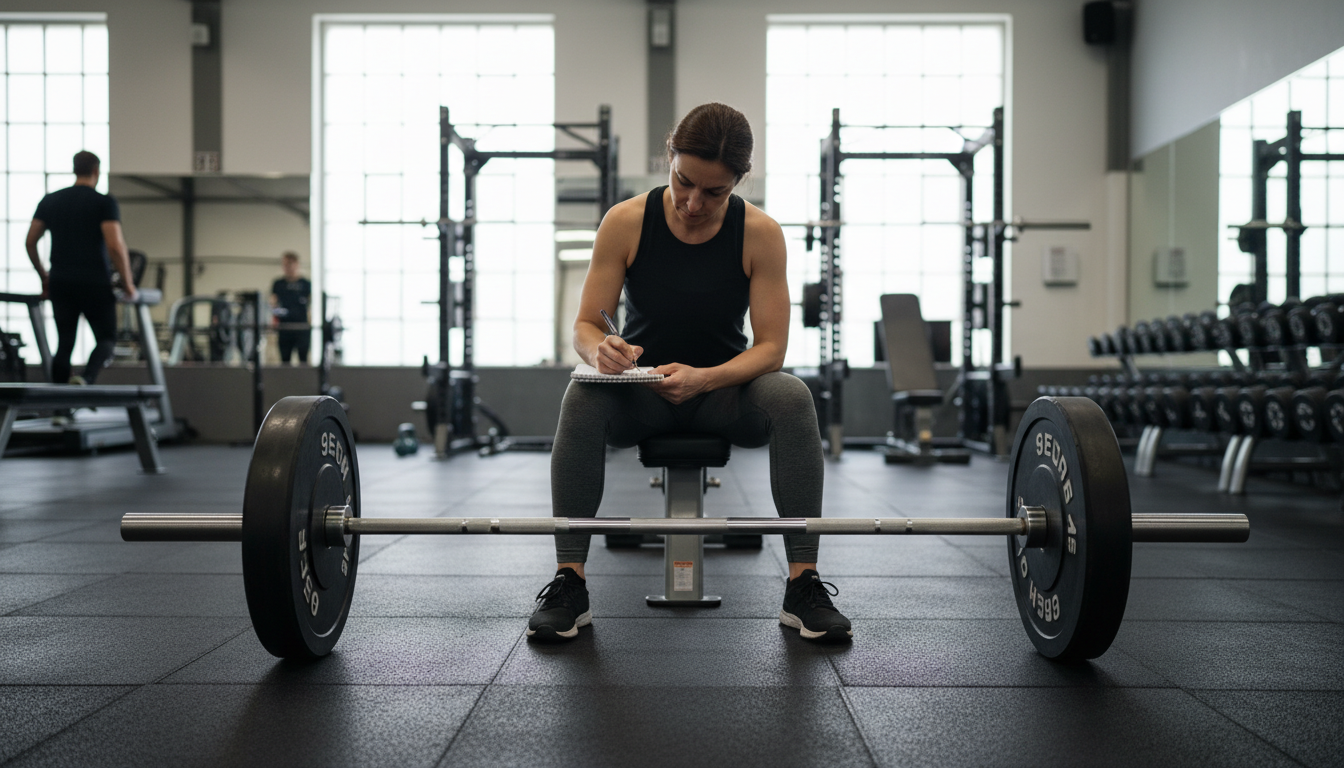
- Do not register the series. If you rely on memory, progressive overload becomes impossible.
- Skipping the break. A download week Every six to eight weeks it maintains the quality of the hard sessions.
How MyPeak helps you see your real progress
The underlying problem is that hypertrophy progresses too slowly to be noticeable without data. That's where a tracking app changes the game. MyPeak You record each set in seconds and the app takes care of the rest: it calculates your weekly volume, estimates your 1RM in the basics, marks your personal records and shows you the strength curve of each exercise over the months.
You can also record your body measurements and weight, so when you're unsure if you're making progress, just open your history. The AI Coach analyzes your data and suggests when to increase the load, when to maintain it, and when to reduce it. No social media, no external comparisons: just your private progress. If you want to fine-tune your strength training, our guide will also be helpful. calculate your 1RM.
Frequently Asked Questions
Is it possible to gain muscle and lose fat at the same time?
Yes, but with conditions. This happens especially with beginners, people returning after a break, and those starting with a high body fat percentage. For someone with years of training experience, the process is much slower, and it's usually more beneficial to separate bulking and cutting phases.
How long will it take to notice visible changes?
You'll start noticing differences in your clothes and appearance between weeks 8 and 12. People around you usually comment on it starting around the fourth or fifth month. A noticeable change for anyone who sees you requires eight to twelve months of consistent effort.
Does training more days speed up the process?
Only up to a point. What matters is your effective weekly volume and your ability to recover. Going from two to four sessions usually improves results considerably. Going from five to six rarely adds anything if you don't also increase your food intake and rest.
Conclusion
Gaining muscle is slow, measurable, and fairly fair: it almost always rewards those who accumulate years of experience, not those who accumulate peak performance. A beginner can expect to gain around 8-12 kg in their first year; an intermediate, 4-6 kg; and an advanced, 2 kg. If your expectations align with these numbers, you'll stop getting frustrated and start enjoying the process.
All you need now is a system to keep track of your progress. Download MyPeak Start recording your workouts today: in six months you'll be grateful to have data that doesn't exist today.