
If you train strength seriously, sooner or later it will happen to you. calculate your 1RMThe maximum weight you can lift in a single repetition of an exercise. It's the most widely used metric for programming sets, adjusting intensity, and measuring whether you're actually progressing. And the good news is, you don't need to risk pushing yourself to the limit every month to find out.
In this guide you will see exactly what the maximum repetition is, the three most reliable formulas to estimate it from submaximal weights, a quick table with the percentages you need and the mistakes that most people make when applying it.
What is 1RM and why should you know about it?
The 1RM (of One Repetition Maximum or "one repetition maximum") is the maximum weight you can lift once with proper form in a given exercise. For example, if your 1RM in bench press is 100 kg, it means you can do one repetition at 100 kg but not two.
Knowing your 1RM has three clear advantages:
- Programs with precision. Most serious routines use percentages of 1RM to define sets and repetitions.
- You measure real progress. If your 1RM increases, you're gaining strength. If it doesn't increase for weeks, there's a problem with your training program.
- You avoid stagnation. Knowing where you are allows you to adjust the load before you get stuck.
Why is calculating your 1RM better than testing it?
Performing a true 1RM test has its uses, but it's not something you should do every week. It involves enormous neural effort, requires spotters, warms up the entire session for a single attempt, and increases the risk of injury if your technique fails under maximum loads.
Therefore, the most practical option is calculate 1RM indirectly Starting with a submaximal weight and the number of repetitions you've achieved, the formulas estimate your maximum with more than enough accuracy to program training, especially in the 2-10 repetition range. Above 10 reps, the results become unreliable because muscular endurance factors come into play.
The 3 most reliable formulas to calculate your 1RM
There are many formulas, but these three have aged the best and are the ones you'll see in any serious study on maximum force estimation.
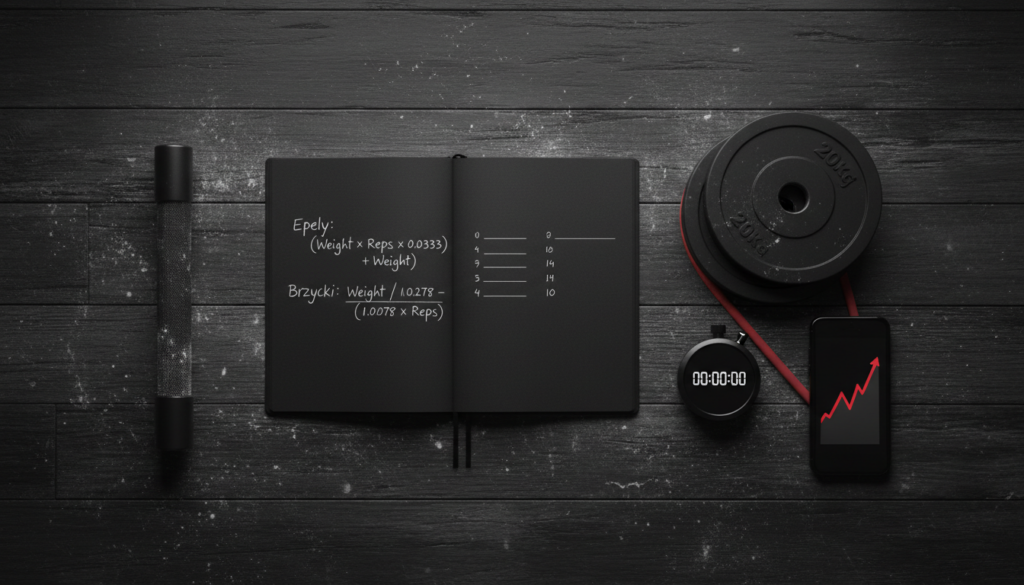
Epley formula (the most commonly used)
It is the most popular because of its simplicity and because it works well in mid-ranges:
1RM = Weight × (1 + Reps / 30)
Practical example: if you squat 80 kg for 6 repetitions, your estimated 1RM would be 80 × (1 + 6/30) = 80 × 1.2 = 96 kg.
Brzycki's formula
It tends to be slightly more conservative than Epley in low repetitions:
1RM = Weight / (1.0278 − 0.0278 × Repetitions)
Using the same example (80 kg × 6 reps): 80 / (1.0278 − 0.0278 × 6) = 80 / 0.861 = 92.9 kg.
Lombardi's Formula
It tends to give slightly higher values and works well with higher repetitions:
1RM = Weight × Repetitions^0.10
Using the same example: 80 × 6^0.10 = 80 × 1.196 = 95.7 kg.
Which one to use? For general use, Epley and Brzycki are the most reliable combination. Calculate using both, average them, and you'll have a realistic value.
Quick chart: percentage of 1RM and repetitions
This table summarizes how many repetitions can typically be performed at each percentage of 1RM. It's the classic reference found in most strength training manuals:
- 100 % of the 1RM → 1 repetition
- 95 % → 2 repetitions
- 90 % → 4 repetitions
- 85 % → 6 repetitions
- 80 % → 8 repetitions
- 75 % → 10 repetitions
- 70 % → 12 repetitions
- 65 % → 15 repetitions
- 60 % → 18-20 repetitions
These numbers are for guidance only. Some advanced athletes can perform more reps at higher percentages due to better neural efficiency, while beginners typically perform fewer. Therefore, calculating your 1RM from your own data will always be more accurate than copying the table.
How to use your 1RM to program your training
Once you have the data, you can adjust the intensity according to your goal. These are the most commonly used ranges.
To gain maximum strength
He works at 85-95 % of the 1RM in sets of 2 to 5 repetitions, with long rest periods (2 to 5 minutes). This is the classic range for powerlifting routines and for evidence-based programs to build pure strength.
To gain hypertrophy
The optimal range is between 65 % and the 80 % of the 1RM, with sets of 6 to 12 repetitions and rest periods of 60 to 120 seconds. Here you aim to build quality volume without exhausting the nervous system.
For muscle endurance
Below the 60 % of the 1RM, With repetitions above 15 and short rest periods. Useful as a supplement, not as a base if your goal is strength or muscle mass.
5 mistakes when calculating 1RM (and how to avoid them)
- Using repetitions with poor technique. If you perform the last few reps with a bounce or assistance, your estimated 1RM will be inflated. Only count clean reps.
- Calculate with more than 10 repetitions. The formulas lose accuracy. For reliable results, use sets of 2 to 8 repetitions.
- Forget the RIR. If you stopped with 2 reps in reserve (RIR 2), your actual 1RM is higher than your calculated 1RM. Always estimate using sets close to failure.
- Do not update it. Your 1RM changes over time. Recalculate it every 4-6 weeks to ensure your percentages remain accurate.
- Apply the 1RM from one exercise to another. Your 1RM for squats is not useful for programming deadlifts. Each exercise has its own maximum.
Calculate your 1RM automatically with MyPeak
Doing these calculations by hand every week is tedious, and comparing formulas is even more so. That's why MyPeak It automatically calculates your estimated 1RM for each exercise you log. Every time you enter a set, the app updates your 1RM, plots your progress curve, and tracks your personal records without you having to do anything.
Furthermore, the AI Coach uses this data to detect if you've been stuck in a particular exercise for weeks and suggests specific adjustments. It's the difference between tracking your progress on a spreadsheet and understanding what's really happening with your strength.
Conclusion
Calculating your 1RM is one of those small habits that separates those who go to the gym from those who don't. train. You don't need to risk it with a maximum test every month: with a formula like Epley or Brzycki, a series close to failure and a minimum of consistency you have solid data to plan and measure your progress.
If you want to forget about the accounts and focus on lifting weight, Download MyPeak for free and let the app calculate, record, and analyze for you.